
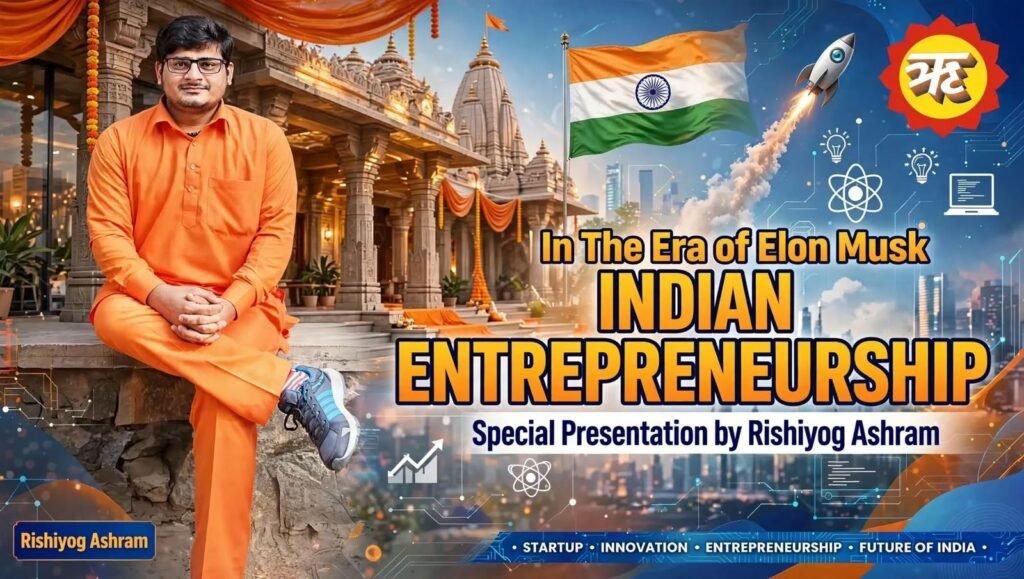

Entrepreneurship of the Rishis in the Age of Elon Musk: Can India Offer a New Model to the World?
By Swami Ashutosh Rishiyogi
1. Elon Musk and the Power of Ideas
 In the modern world, Elon Musk has emerged as a symbol of technological entrepreneurship. Through companies such as Tesla and SpaceX, he has demonstrated how ambitious ideas, scientific innovation, and calculated risk-taking can transform industries and reshape humanity’s future.
Musk is not merely building electric vehicles or developing rockets. He is attempting to redefine how human beings travel, produce energy, and potentially establish a presence beyond Earth. His work demonstrates that entrepreneurship is not simply about earning money; it is also about turning ideas into systems that influence the direction of civilisation.
But this raises an interesting question: Can we understand the ancient Indian rishis as a different kind of entrepreneur—entrepreneurs of knowledge, consciousness, and human values?
The comparison is not intended to suggest that ancient sages and modern technology entrepreneurs operated in identical ways. Rather, it invites us to explore a broader meaning of entrepreneurship: the ability to develop valuable ideas, organise knowledge, create institutions or traditions around them, and transmit them to future generations.
2. The Rishis as Entrepreneurs of Knowledge
India’s rishis did not build rockets or automobiles. Their field of exploration was different. They investigated consciousness, existence, language, ethics, suffering, liberation, and the relationship between human beings and the universe.
Their work produced diverse intellectual and spiritual traditions. The Upanishads explored profound questions about the self and ultimate reality. The philosophical schools developed systematic approaches to knowledge and existence. The epics and Puranas transmitted cultural ideas through stories, characters, symbols, and narratives. The Bhakti traditions made spiritual expression accessible to people through devotion, poetry, music, and regional languages.
In this sense, the rishis can be viewed as entrepreneurs of knowledge. They developed ideas, refined methods of inquiry, established teaching traditions, and created ways through which knowledge could travel across generations.
Their achievements were not limited to producing abstract philosophies. Their ideas influenced education, literature, art, social life, religious practices, and the ways in which millions of people understood themselves and the world.
This form of entrepreneurship was not necessarily commercial. Its central objective was the creation and transmission of intellectual, cultural, and spiritual value.
3. India’s Linguistic Heritage: A Powerful Intellectual Resource
One of India’s greatest contributions to the world is its rich linguistic and intellectual heritage.
Sanskrit became a major language of philosophy, literature, grammar, ritual, and scholarship. Pāṇini’s Aṣṭādhyāyī, a remarkably systematic work on Sanskrit grammar, demonstrates the sophistication of ancient Indian linguistic analysis.
India also developed an extraordinary range of regional languages and literary traditions. Tamil, Hindi, Bengali, Marathi, Telugu, Kannada, Malayalam, Punjabi, and many other languages have carried philosophical ideas, devotional poetry, folk wisdom, and cultural knowledge across generations.
It would be historically inaccurate to describe Sanskrit as the mother of every language. Languages have distinct histories and belong to different linguistic families. Nevertheless, Sanskrit and India’s other classical languages have made significant contributions to world intellectual history.
The larger lesson is that language is not merely a means of communication; it is a vehicle for transmitting knowledge, shaping thought, and building civilisations.
If India wants to share its philosophical and spiritual heritage with the world, translation and multilingual communication must become central to that effort.
A profound idea reaches only a limited audience if it remains confined to a language understood by a small group. When the same idea becomes available in English, Spanish, Arabic, Chinese, Russian, German, Japanese, and other languages, its potential audience expands dramatically.
This is where ancient Indian wisdom and modern entrepreneurship can work together.
4. How Spiritual Ideas Travel Through Different Ages
Indian spiritual traditions have never remained confined to a single form of expression.
The Vedic tradition developed through hymns, rituals, and reflections on cosmic order. The Upanishads placed increasing emphasis on philosophical inquiry into the self and ultimate reality. The epics communicated ethical dilemmas and spiritual teachings through compelling narratives. The Puranas developed rich worlds of stories, symbols, and devotional traditions. The Bhakti movements expressed spirituality through songs, poetry, and the languages spoken by ordinary people.
These developments should not be understood as one simple, uniform historical sequence. Different traditions evolved in different regions and periods, often overlapping and influencing one another.
Yet they reveal an important principle: the transmission of knowledge changes as society changes.
A teaching that once travelled through oral traditions may later be preserved in manuscripts, books, printed publications, audio recordings, videos, mobile applications, or online courses.
The essential message may remain recognisable even as its medium changes.
In the modern world, spiritual teachers and knowledge creators have access to technologies that earlier generations could scarcely have imagined. A lecture delivered in a small Indian town can potentially reach an audience across continents. A traditional philosophical text can be explained through animation, podcasts, interactive lessons, and translations.
The challenge is no longer simply to preserve knowledge. It is to make that knowledge understandable, accessible, relevant, and useful to contemporary audiences.
5. From Osho to the Modern Spiritual Knowledge Economy
Modern spiritual teachers have also demonstrated that traditional ideas can reach new audiences when presented through contemporary forms of communication.
Osho, for example, became internationally known through his discourses on meditation, awareness, philosophy, and human psychology. His influence and interpretations remain subjects of debate, but his global reach illustrates the potential of combining spiritual discourse with publishing, recordings, translations, and organised centres.
The broader lesson is not that every spiritual teacher should imitate a particular personality. It is that ideas need effective methods of communication if they are to reach people beyond their original setting.
Today, spiritual knowledge can be shared through books, digital courses, meditation programmes, retreats, podcasts, social media, and multilingual educational platforms.
This creates the possibility of a modern spiritual knowledge economy—one in which teachers and organisations can sustain their work financially while making meaningful educational and spiritual contributions.
Commercial sustainability and spiritual integrity do not have to be enemies. However, they must be balanced carefully. Transparency, intellectual honesty, responsible teaching, and respect for different traditions are essential if spiritual entrepreneurship is to earn public trust.
6. My Experiment: Twenty-Five Spiritual Programmes
As Swami Ashutosh Rishiyogi, I have developed 25 spiritual programmes that draw upon different traditions, teachings, and approaches to inner development.
These programmes explore a wide range of subjects, including the teachings associated with Ram, Krishna, Shiva, the Divine Mother, and Ganapati; the Bhaktamal tradition; the Upanishads; Sikh wisdom associated with Guru Nanak; Sahaj Yoga; Buddhist teachings; meditation; and other philosophical and spiritual paths.
My intention is to make these traditions available to people through structured programmes that can be presented, explained, and shared with diverse audiences.
The vision is not to suggest that all traditions are identical, or that their differences should be ignored. Each has its own history, concepts, practices, and cultural context. The objective is to approach them with care and help people explore their teachings in an accessible way.
The next step is to make these programmes available in multiple languages and through suitable digital formats. A person should be able to discover a programme, understand its purpose, participate in it, and continue learning regardless of geographical boundaries.
For this purpose, technology can become a bridge between traditional wisdom and modern audiences.
Artificial intelligence, translation tools, online learning platforms, video production, and digital publishing can help reduce language and geographical barriers. Human expertise will remain important for ensuring that translations are accurate, context is preserved, and sensitive teachings are not distorted.
The opportunity is to create a model in which spiritual knowledge is not merely discussed but systematically developed, communicated, and made accessible to the world.
7. Why India Needs Spiritual Entrepreneurs
India has a substantial opportunity to contribute to the global conversation on spirituality, philosophy, meditation, yoga, and the search for meaning.
But possessing a rich heritage is not the same as successfully sharing it.
A tradition may contain profound ideas, yet those ideas can remain inaccessible if they are poorly documented, inadequately translated, presented without context, or disconnected from the needs of contemporary audiences.
This is where entrepreneurship becomes relevant.
A spiritual entrepreneur must do more than deliver a discourse. They need to understand their audience, develop well-designed programmes, create high-quality educational material, use appropriate technology, build a trustworthy identity, and establish sustainable ways to reach people.
For example, a single philosophical idea could be developed into a book, a short video series, a university-style lecture, a meditation workshop, and a translated online course. Different formats could serve different audiences without abandoning the original idea.
Young Indians could build careers in this emerging field through translation, research, educational technology, digital publishing, documentary production, meditation instruction, and the development of responsible learning platforms.
Such work can create economic opportunities while contributing to cultural preservation and intellectual exchange.
However, success should not be measured solely by the number of followers, views, or revenue generated. The quality of teaching, the depth of understanding, the well-being of participants, and the credibility of the material matter just as much.
8. The Need to Combine Ancient Wisdom with Modern Technology
The future does not require India to choose between ancient wisdom and modern science.
Technology can improve communication, education, healthcare, mobility, and the organisation of human activity. Philosophical inquiry and contemplative traditions can help people examine questions of meaning, responsibility, desire, suffering, and the purpose of life.
These are different domains, and neither should be treated as a substitute for the other. Spiritual claims should not replace scientific evidence where empirical investigation is required. Equally, technological progress alone cannot settle every ethical or existential question.
The opportunity lies in bringing different forms of knowledge into a constructive relationship.
Just as an entrepreneur can use technology to make a product available to millions of people, a spiritual knowledge creator can use digital platforms to make carefully presented teachings accessible to people across the world.
But reach must be accompanied by responsibility. Historical claims should be verified, traditions should be represented fairly, and commercial ambitions should not encourage exaggerated promises or the exploitation of people seeking spiritual guidance.
A genuinely valuable spiritual enterprise would combine accessibility with authenticity, innovation with discipline, and financial sustainability with a commitment to human development.
9. Can India Offer a New Model to the World?
The question is not whether ancient Indian rishis were literally the same as modern entrepreneurs. They lived in different historical circumstances and pursued different objectives.
The more useful question is whether their approach to inquiry, teaching, and the transmission of knowledge can inspire new forms of entrepreneurship today.
India can build modern institutions and digital platforms that bring together philosophy, language, meditation, literature, and education. It can develop multilingual resources that explain its intellectual traditions to people who have never encountered them. It can support research, encourage responsible spiritual teaching, and create sustainable models for sharing knowledge.
This requires more than admiration for the past. It demands organisation, investment, quality control, collaboration, and a willingness to communicate in forms that contemporary audiences can understand.
The world does not need exaggerated claims about India’s superiority. It needs thoughtful contributions that can be examined, experienced, questioned, and put to meaningful use.
India’s spiritual heritage can become a living contribution to humanity when it is presented with intellectual honesty and made accessible beyond linguistic, geographical, and cultural boundaries.
Conclusion: Do Not Merely Celebrate the Past—Create the Future
Elon Musk represents one modern model of entrepreneurship: the use of technology, capital, scientific research, and ambitious execution to transform the material possibilities of human life.
The Indian rishis represent diverse traditions of inquiry into consciousness, existence, knowledge, and the human condition. Their legacy offers another source of inspiration—not a replacement for science or technology, but a distinct body of intellectual and spiritual resources.
The challenge before contemporary India is to bring its heritage into a meaningful relationship with the possibilities of the modern world.
For me, the development of 25 spiritual programmes is one step in that direction. The larger vision is to make the wisdom of different traditions accessible to people across countries and languages, while respecting their individual identities and historical contexts.
If technology can carry human beings beyond geographical boundaries, it can also help ideas travel beyond linguistic and cultural boundaries.
India must not merely take pride in the wisdom of its past. It must use that wisdom responsibly to help shape the future.
That is the possibility of spiritual knowledge entrepreneurship—and the opportunity for India to offer the world a model grounded not only in innovation, but also in reflection, meaning, and human development.
See less